2026 • Runner-up, Quant-A-Thon 2026 Finals
RadarSense
AI radar target classification with a real 77 GHz DSP front-end
What it is
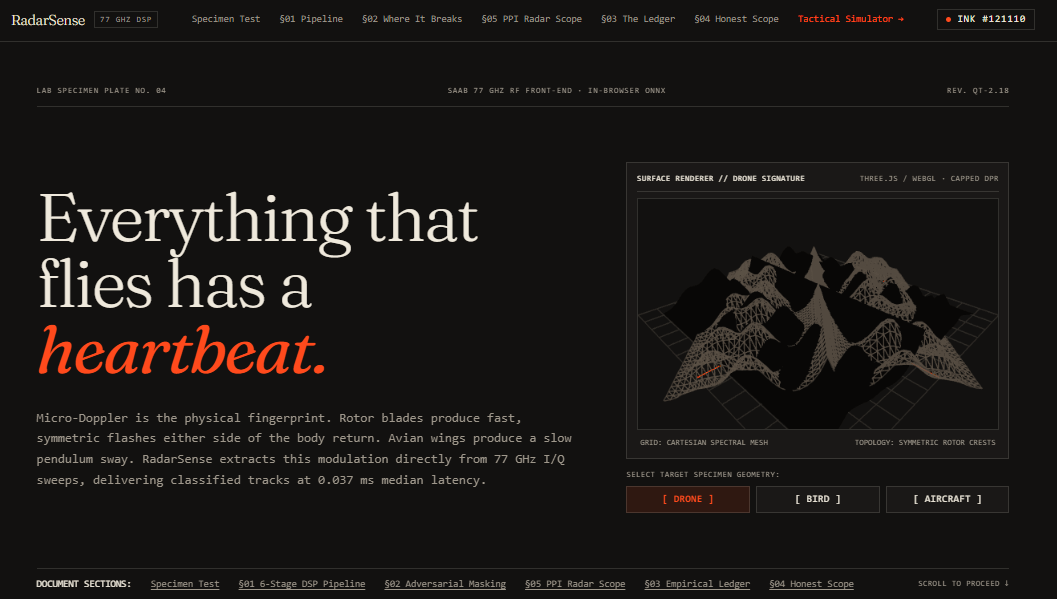
RadarSense is an AI radar target classification system built by Team CodexCreators for Quant-A-Thon 2026, where it finished runner-up in the finals. It processes raw radar I/Q samples through a real 77 GHz DSP front-end: range-Doppler FFT, CA-CFAR detection and Kalman tracking, then classifies targets with a cost-sensitive CatBoost model.
The headline result is measured honestly. On real SAAB SIRS data, RadarSense scored 92.2% accuracy, plus or minus 3.1%, under leak-free measurement-grouped cross-validation with 5-fold GroupKFold. Drone recall was 91.8% at 77.5% precision. Certified robustness via randomized smoothing makes 83% of predictions provably un-evadable, and a micro-Doppler masking defence lifts recall from 12.3% to 76.9% under attack. The deployed ONNX model is 2.67 MB.
RadarSense also includes a quantum-kernel investigation using Qiskit and PennyLane. That branch is reported as a negative result against the classical model, not as a quantum advantage claim. The work was accepted as paper 1571382056 at IEEE AGERS 2026, presented online on 17-18 December 2026 under the title Hybrid Classical-Quantum Learning for Offline Radar Drone Classification.
Results
- Accuracy, grouped CV
- 92.2% +/- 3.1%
- Real SAAB SIRS data, leak-free 5-fold GroupKFold
- Drone recall
- 91.8%
- At 77.5% precision
- Certified robustness
- 83% provably un-evadable
- Randomized smoothing
- Masking defence recall
- 12.3% to 76.9%
- Under micro-Doppler masking attack
- ONNX model size
- 2.67 MB
- Deployed model
Technology stack
- Python
- CatBoost
- FastAPI
- Next.js
- ONNX
- Qiskit
- PennyLane
- Scikit-Learn
- 77 GHz DSP
Links
Frequently asked questions
What data was RadarSense tested on?
Real SAAB SIRS radar data, evaluated under leak-free measurement-grouped cross-validation so segments from the same measurement cannot leak between train and test folds.
Is RadarSense a real-time system?
No. The AGERS 2026 paper evaluates it offline. Real-time and multi-band claims were removed from the revised paper because they were not evaluated.
Did the quantum model beat the classical model?
No. The quantum-kernel investigation is reported as a negative result against the classical CatBoost model, with honest empirical bounds on current NISQ quantum kernel advantages.
More projects
- Ranqora
Autonomous AI dataset discovery and adaptive ranking for researchers
- CampusVersa
Unified education governance platform, Smart India Hackathon 2025 winner
- ChakshuAI
Clinical diagnostic intelligence for ophthalmic screening
- VGAM-Net
Attention-gated deep learning for retinal vascular analysis